

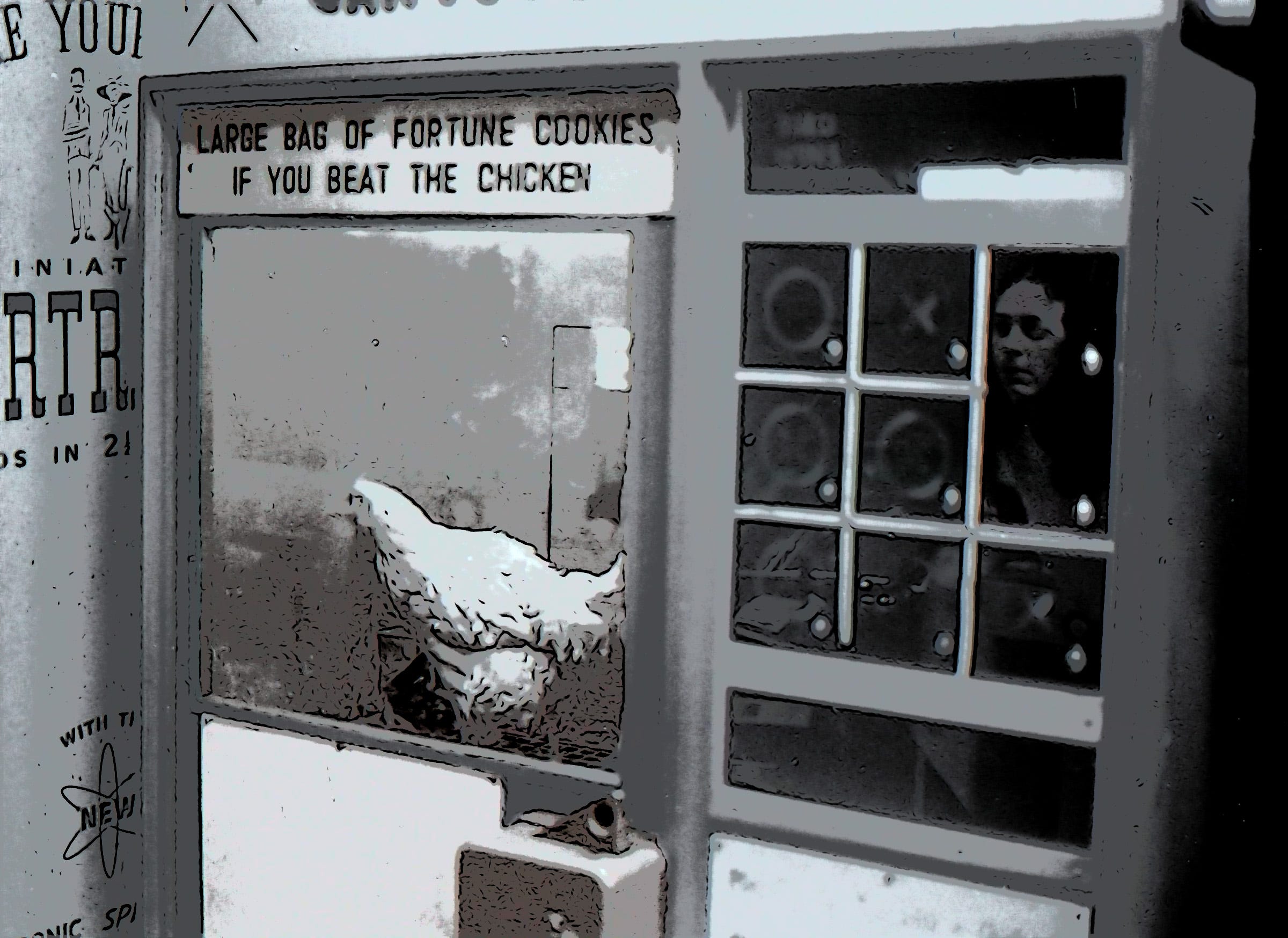
A sad, captive chicken lived in an enclosed glass box next to shelves of dusty canned goods at the back of a small Asian market. Upon entering the market, any customer with reasonable hearing heard the bored chicken scratching and pecking in the confined space. PETA used to send angry letters to the store owners, an elderly couple who immigrated from Bengbu, China, demanding the chicken’s release. But the tragic fate of hundreds of bushels of lobsters sold at the fish market down the block caught PETA’s attention, and the letters stopped. One chicken’s isolated confinement seemed hardly worth the effort when compared to the suffering of hundreds of lobsters sentenced to a cruel, boiling death.
There was an electrified panel inside the glass box with a large tic-tac-toe grid for the chicken to peck at, and a matching grid panel on the outside of the box for a customer. It cost 50 cents a game to match wits with the chicken. Anyone who beat the chicken at tic-tac-toe won a bag of fortune cookies. No one remembered the last time the chicken lost.
Leo, an older man from the neighborhood who was just shy of retirement but without any plans, would stop by the store on his way home from work. Leo was driven to beat that chicken before leaving the workforce. He knew he wasn’t going to get a gold watch or even much of a goodbye. Leo didn’t have any friends at work. He needed that win. It wasn’t about the fortune cookies but something deeper.
On a warm spring afternoon, a month before Leo’s last day at the loading dock, his mood was strangely upbeat. With unusual confidence, Leo entered the store, walked directly to the game, and dropped in two quarters. The chicken pecked first, selecting an O in the middle square. House rules: the chicken always goes first. Leo punched an X in the square above the chicken’s O. Without hesitation, the chicken pecked an O next to the first one. Leo paused to consider a strategy, trying to think a couple of moves ahead. That’s when he saw her reflection in the glass.
She wasn’t a traditional beauty. She looked to be as old as Leo, but wholesome, like she lived her life with a no-frills authenticity and grace. She carried a simple, plain-spoken beauty, someone at peace with themselves and happy with their world. In an instant, Leo knew that he could be with her, that she could fill his heart. They could be a unit. Leo hadn’t been with anyone since his divorce fifteen years before. Forgetting the game, he focused on her reflection, seeing a whole new life in it. His breath became shallow. Somehow, he just knew it could work.
Still watching her reflection, trying to think of something to say to break the ice, she turned to him, her serene expression turning to shock. “Oh!” she said. But it wasn’t Leo that startled her. She was looking at the chicken. Leo watched as she screamed at the owners. “How can you do that to a poor chicken?” Then she stormed out. As quickly as his heart swelled with possibility, it now deflated like a neglected party balloon. Leo knew he would never see her again.
Leo didn’t care about winning anymore, but he kept playing out of habit. He blindly picked, and the chicken pecked. Without trying, losing all investment in the game’s outcome, Leo won. A rusty bell mounted on top of the chicken’s box automatically rang, announcing his win to the owners. Leo grabbed his bag of fortune cookies from one of the owners on his way out, not acknowledging their obligatory “Congratulations!” It was a hollow win, a booby prize.
Leo opened the bag of fortune cookies while he walked down the block to his lonely studio apartment. He plucked a cookie from the bag and broke it open. He read the fortune while munching on the stale treat. You will be poorly dressed and alone when you die, the fortune read. “Goddamn chicken,” Leo muttered to himself.